How Much Does Managed IT Support Actually Cost in Australia

It is almost always the first question. And most IT providers dance around it with something like "it depends on your requirements" before eventually getting to a number.
That answer is not wrong. But it is not particularly useful. Managed IT support costs in Australia do vary significantly, but the factors that drive that variation are consistent and predictable. Understanding them puts you in a much better position to evaluate quotes and judge whether you are looking at fair value or not.
Here is a straight answer on how managed IT pricing works, what it typically includes, and what the numbers actually look like for Australian businesses.
How Managed IT Pricing Models Work
Most managed IT providers in Australia use one of two primary pricing structures: per-user or per-device. Some use a hybrid of both.
The per-user model charges a monthly fee for each employee covered under the agreement. This tends to suit businesses where employees access IT resources from multiple devices, because it accounts for the whole person rather than individual endpoints.
The per-device model charges per managed device: desktops, laptops, servers, and sometimes network equipment. It tends to suit environments with a fixed device-to-user ratio and clear hardware boundaries.
Both models are legitimate. The right one depends on how your business is structured and what you are actually asking the MSP to manage.
What Typical Managed IT Costs Look Like in Australia
For small to medium Australian businesses, managed IT pricing generally falls in these ranges:
- Per-user arrangements: roughly $80 to $200 per user per month, depending on the scope of services included
- Per-device arrangements: roughly $50 to $150 per device per month for standard endpoints
- Server management is typically priced separately and ranges from $200 to $500 per server per month depending on complexity
These are indicative ranges. A lighter-touch arrangement covering basic monitoring and helpdesk will sit at the lower end. A fully managed, security-focused engagement with strategic support will sit higher.
What Is and Is Not Typically Included
Understanding what the fee actually covers is at least as important as the number itself. A lower monthly price that excludes common services is not always the better deal.
Standard inclusions at most reputable MSPs include proactive monitoring, patch management, helpdesk support within agreed response times, antivirus and endpoint protection, and regular reporting. Software licensing, hardware procurement, project work, and on-site visits are often outside the base scope and charged separately.
Before signing any agreement, it is worth getting clarity on what triggers an out-of-scope charge, how project work is estimated, and whether your industry has any compliance requirements that affect what the MSP needs to deliver.
The Factors That Drive Price Up or Down
Several variables move the price significantly in either direction. A more complex environment costs more to manage because it requires more expertise and more time. A business in a regulated industry, such as financial services, legal, or healthcare, will typically require a higher level of security compliance and documentation.
Geographic spread matters too. A business with multiple sites requires more coordination and potentially more on-site support. Conversely, a fully cloud-based environment with standardised devices is often cheaper to manage than a mixed on-premises and cloud setup.
The size of the business also affects unit cost. Larger engagements typically attract lower per-user pricing because the MSP can achieve efficiencies of scale across a bigger environment.
What Managed IT Support Costs Versus In-House IT
The comparison most decision-makers reach for is hiring an internal IT person versus engaging an MSP. The numbers are often not as close as they look.
A mid-level IT generalist in Brisbane costs between $70,000 and $100,000 per year in salary, before superannuation, leave entitlements, training, tools, and recruitment costs. One person also cannot cover everything: a single IT employee has a fixed skill set and is unavailable outside working hours.
An MSP provides a team of specialists across security, networking, cloud, and helpdesk, with cover that extends beyond business hours, at a total cost that is usually lower than a single full-time hire once all employment costs are factored in. The Australian Cyber Security Centre notes that access to specialised cybersecurity skills in particular is a persistent challenge for businesses that rely solely on internal IT resources.
How MIACOR IT Structures Its Engagements
MIACOR IT takes a tailored approach to managed IT support pricing rather than applying a fixed package to every client. The engagement is scoped to what the business actually needs, which means you are not paying for services you will not use.
The team provides a clear breakdown of what is included, what sits outside scope, and how additional work is handled before any agreement is signed. There are no surprises on the invoice at the end of the month.
MIACOR IT works with businesses across Brisbane and Australia, from SMBs building their first structured IT function through to established organisations that need specialist support across specific areas.
Get a Clear Quote Before You Commit to Anything
The best way to understand what managed IT support will cost for your specific business is a scoping conversation with a provider who takes the time to understand your environment.
Talk to the MIACOR IT team about your requirements or see what the managed IT service covers.
Frequently Asked Questions About Managed IT Support Costs in Australia
How much does managed IT support cost per user in Australia?
Most Australian MSPs charge between $80 and $200 per user per month, depending on what is included in the scope. Basic monitoring and helpdesk sits at the lower end; fully managed, security-focused engagements with strategic support sit higher.
Is managed IT support cheaper than hiring an internal IT person?
For most small to medium businesses, yes. An MSP provides a team of specialists across multiple disciplines at a total cost that is usually lower than a single full-time IT hire once salary, super, leave, and tools are factored in. The coverage is also broader and available outside standard working hours.
What is typically included in a managed IT agreement?
Standard inclusions are proactive monitoring, patch management, helpdesk support within agreed response times, endpoint protection, and regular reporting. Project work, hardware, software licensing, and on-site visits outside standard scope are often charged separately.
What triggers additional charges on a managed IT agreement?
Out-of-scope charges typically arise from project work (migrations, deployments, major upgrades), hardware procurement, extra sites or devices not included in the original count, and work outside agreed hours. A reputable MSP will define these clearly in the agreement before you sign.
How do I know if I am getting fair value from my MSP?
Compare what is included in the scope against what you actually use. Ask for regular reporting that shows monitoring activity, issue resolution times, and patch compliance. If you cannot get clear answers on these, that is itself a signal worth paying attention to.
Related posts
.png)
Queensland Government Suppliers: Is Your Cyber Security Ready for 2027?
How Much Does Managed IT Support Actually Cost in Australia

How Proactive IT Monitoring Prevents Costly Downtime for Businesses

What Is a Managed IT Service Provider? And Do You Need One?

5 Signs Your Business Has Outgrown Its Current IT Setup
EOFY IT Audit Checklist - Stop SaaS Waste
.png)
The Hidden Challenges of Scaling Cloud IT for Fast Growing Businesses
%20(1).png)
MIACOR IT achieves ISO 27001:2022 Certification
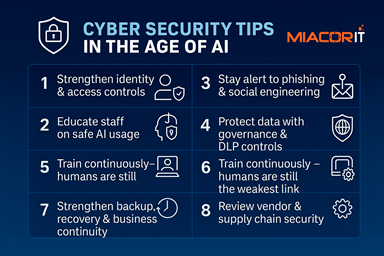
🔐 Cyber Security Tips in the Age of AI

Prevent data leaks

Understanding the Virtual Environment

Windows Server and SQL Server on Azure

3 Fundamentals for a Successful Hybrid Cloud

6 Easy Ways to save money on your IT while increasing your security!

How to improve productivity for you and your team while working from home